


Looking beyond the data at Continuing Care and Aftercare

The Children’s Social Work Statistics for Scotland (CLAS stats) tells us that 22% of eligible ‘looked after’ children and young people were supported by Continuing Care across Scotland in July 2024, that is, that after their sixteenth birthdays they were able to stay where they were living with their current carers, up until the age of 21. This is an increase to 1,115 young people from 777 young people in July 2023.
Any increase in the number of young people accessing their right to Continuing Care is to be welcomed; however, this increase in numbers may be in part due to improved identification of the number of young people in receipt of Continuing Care, rather than solely due to more young people exercising their right. Whilst 22% is a substantial percentage of young people across Scotland, this means that nearly 80% of young people who are eligible for Continuing Care are not accessing it. It is imperative that we go beyond the data to understand why this is.
We can also see that there is wide variation across Scotland and, again, it is important to understand why this may be. CELCIS’s research around the implementation of Continuing Care found, in 2022, that there was inconsistent implementation of Continuing Care across Scotland - not only between local authority areas, but also within local authority areas. Perhaps a helpful measure to include in future data returns might be the percentage of young people who are eligible for and who then go on to exercise their right to Continuing Care in each local authority area, rather than the population rate that is currently published. This would give a clearer picture of variation in uptake across the country. These most recent statistics would appear to echo the findings of this research and tells us that, unfortunately, this variation continues across Scotland, contrary to the intentions of the legislation, the policy and our aspirations to keep The Promise of the Independent Care Review.
What the data tells us about Aftercare
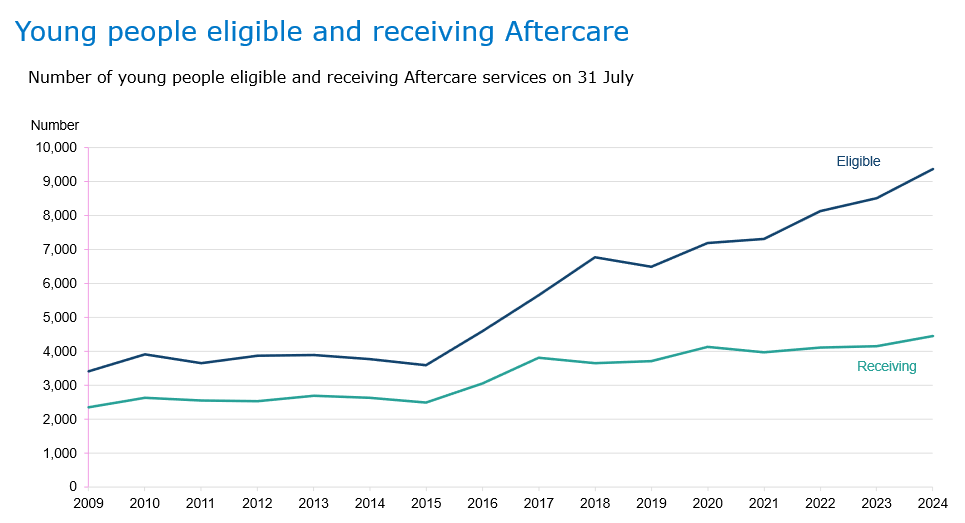
This Scottish Government chart shows that the number of young people eligible for the guidance, assistance, and advice that a local authority provides for care leavers (Aftercare), from their sixteenth birthday up until the age of 26, has risen steadily over time, but that it is climbing much more sharply than the rate of young people who are actually receiving Aftercare.
What the numbers do not tell us is why there is such a gap between those eligible and those receiving Aftercare – is it that many young people don’t wish or need it? Is it to do with a lack of resources? Is it that young people may not be aware of their right to access Aftercare? The answer to all of these questions may help us to better understand the context within which these statistics sit.
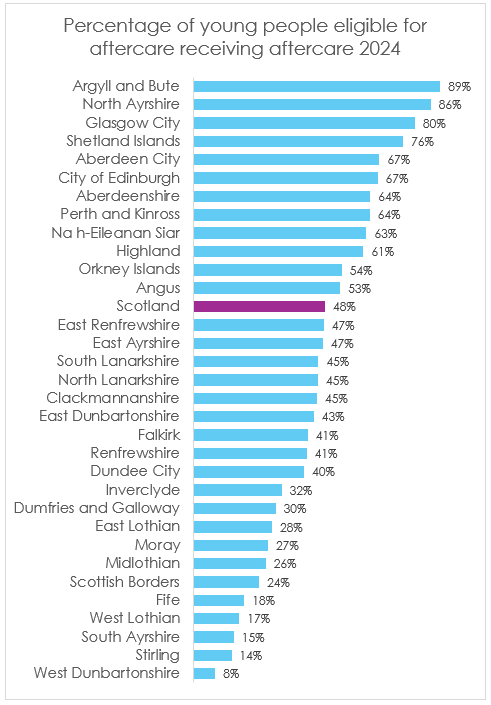
The data also tells us that there has been a 1% decrease from 2023 to 2024 in the number of young people receiving Aftercare across Scotland – from 49% in 2023, to 48% in 2024. Whilst this shows only a 1% change in the national picture, it is important to note that there is substantial variation at a local authority level: ie, the percentage of young people receiving Aftercare support ranges between 8% and 89% between local authorities. This is a stark reminder that it is vital to go beyond a national picture, that essentially ‘averages out’ large variations and to focus on individual areas in order to understand what is going on for individual young people.
The data provided is also limited in only reflecting whether someone is in receipt of ‘an Aftercare service’ or not. But ‘receiving an Aftercare service’ can mean many different things. For example, this doesn’t tell us whether the service was a one-off conversation for some immediate and timely support, or ongoing support for a year or two. It is also important to remember that improvements made this year to how data is collected makes any trend analysis across previous years difficult, so caution is required when considering whether or not there has been an improvement over time in the number of young people receiving Aftercare support.
The importance of understanding the context
My colleague Micky Anderson noted in his recent blog post that local authorities are given the opportunity to revise certain data submitted the previous year. This results in more complete and reliable data, which is to be welcomed, but it does mean that an initial read of the data needs to be considered in this context. Further analysis is also required to understand the differences in the data of individual local authorities compared to the national picture. Crucially, it is vital that we consider the context in which the statistics sit, and to understand the experiences of young people, and the practices that are behind the numbers.
The research into the implementation of Continuing Care that we did at CELCIS in 2022 is not the only insight into how the policy may or may not be working. The Promise (2020); the “Moving On” Change Programme’s “100 Days of Listening” (2024); the Care Inspectorate's Thematic Review regarding Transitions for Care Experienced Young People (2024); and the analysis of responses to the Scottish Government's "Moving on from care into adulthood" consultation (2024), all together indicate the challenges facing children and young people as they transition into adulthood and how the system of support is, or is not, helping them.
There are key themes that appear in all of them:
- Positive, trusted, and sustained relationships are key to supporting young people at all transition points
- There is a need for early planning for young people with experience of care transitioning into adulthood
- Clear pathways and pathway plans would help combat the inconsistency in the implementation of Continuing Care across Scotland
- Greater collaboration between services, especially in relation to mental health services and the links between children and adult social work services
- In the context of a national housing crisis, there is a need for suitable housing to support young people with their own tenancies, and also for foster carers providing Continuing Care
- There is a need to look further at financial modelling to ensure that Continuing Care and all aspects of transitions are sufficiently resourced to ensure that the rights of care leavers are upheld
We must pay attention to each and every one of these.
Looking ahead
With the publication of the Children (Care, Care Experience and Services Planning) (Scotland) Bill there are opportunities to strengthen the support offered, particularly with the proposal for young people who left care before their 16th birthday to be eligible for Aftercare, and the rights of access to care experience advocacy services.
But ten years on from the Children and Young People (Scotland) Act 2014, which introduced Continuing Care and Aftercare, we must also build up our understanding and evidence around how Aftercare, in particular, is being supported by practitioners and experienced by young people.
If the statistics tell us just one thing, it’s that we can’t be confident that all Scotland’s children and young people are getting the care and support they may need and want.
Listen to an audio version of this blog here.
The views expressed in this blog post are those of the author and may not represent the views or opinions of our funders.
Commenting on the blog posts: sharing comments and perspectives prompted by the posts on this blog are welcome.
CELCIS operates a moderation process so your comment will not go live straight away.