

One Hundred Voices: Making real change means really listening
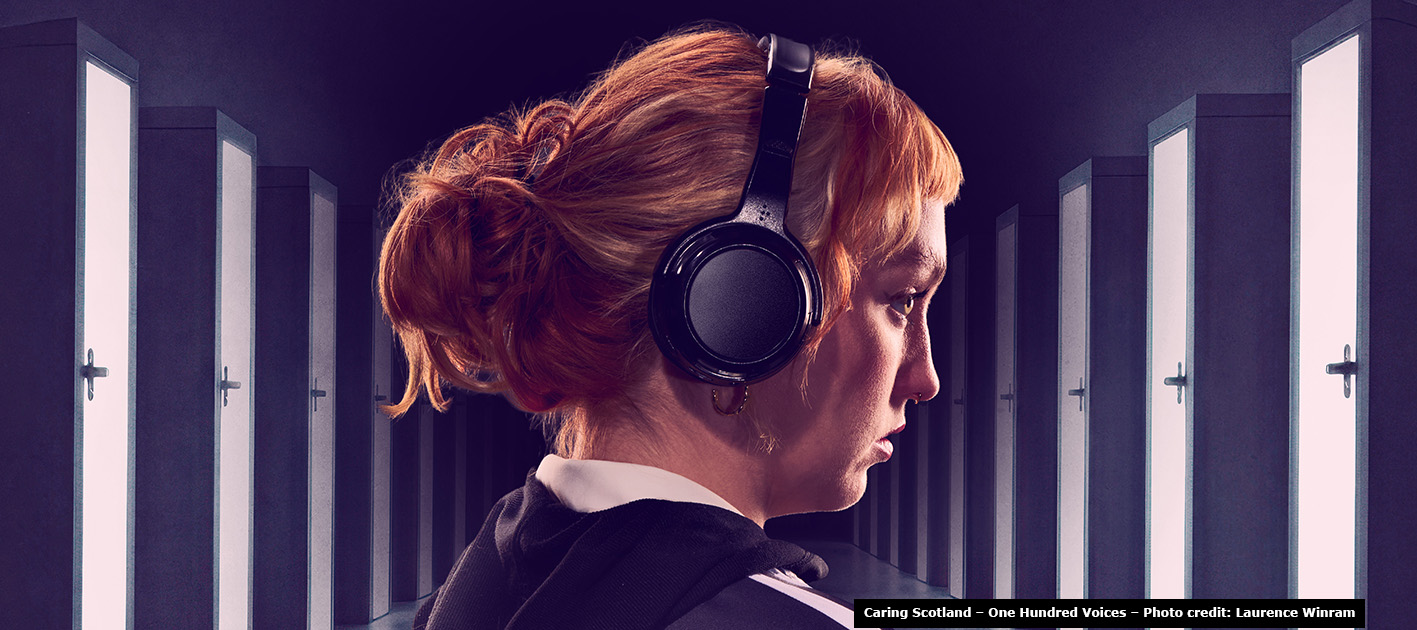
Caring Scotland is a three-year listening project created by the National Theatre of Scotland that aims to raise the profile, celebrate the achievements and foster empowerment of the care experienced community. The project’s creative outputs include an interactive installation, One Hundred Voices, a photographic exhibition, made by care experienced photographer Chris Scott, and a collection of personal stories that will be stored forever at the National Library of Scotland.
The whole project, for me, originates in a sense of rage. I was a foster carer for 16 years for a local authority in Scotland. The emotional abuse and the neglect – I don’t think these are strong terms – that I witnessed children in my care subjected to by the system fuelled my desire to use my skillset to try to get Scotland to care about its care system, especially in the light of the failure so far to deliver The Promise of the Independent Care Review. It seems to me that the public sector will is there, but the resources and support of government is not there yet.
As a playwright and socially engage theatre-maker, I directed, and was the lead artist, on this project. I also conceived the interactive installation. One Hundred Voices - which opened earlier this year at the Scottish Parliament is a walk through theatrical installation comprising seven rooms which the spectator explores with the help of an audio play which they listen to through headphones. It doesn’t put you in the position of a child in the care system, but as a spectator, with the way the installation engages with you, and how it treats you, giving you a physical and emotional sense of how it might feel to be that child.
After donning a high-vis vest with a new name you have to use as you travel, you move through spaces such as the Welcome Room (which isn’t very welcoming when you look closer), the Waiting Room (much like a social services one) and an Admin office where you have to fill in a form about yourself. The audio guide has two voices competing for control: Brian, your official guide, and Kayla, a care experienced 15-year-old. And you also hear some other voices trying to break in – the voices of over one hundred care experienced children and adults we have listened to across the three years of our Caring Scotland Project.
The installation experience is not a typical theatre show – it is immersive and interactive, designed to make you feel what it’s like being subject to the care system in Scotland, and to encourages you to go on to listen to at least one story from those one hundred which now exist in a website and in the National Archives of Scotland – a unique collection of recordings in which our one hundred storytellers, for the first time perhaps, get to tell their own stories in their own words.
I say for the first time, because for care experienced people, their experience is often that their stories are written up in other people’s words – largely for social work reports – or by tertiary sector organisations for reasons of data set collection designed only to ask people to speak about specific things. What I wanted to do was create an opportunity for people to say what they wanted to say about themselves, in the way they wanted to say it.
For eighteen months I led a team of artists of all kinds in this listening project. Listening is at the heart of my process as an artist and is itself an art. I have been very much inspired by Erich Fromm’s “The Art of Listening”, which lists principles for being a good listener. Care experienced people with whom I have worked, find that they are often asked to speak but never really listened to within the broken care system.
The Children (Care, Care Experience and Services Planning) (Scotland) Act 2026 (The Children (Scotland) Act 2026) has the potential to make a huge difference to the lives of children and young people in care. But what will make the biggest difference is that each child actually feels they are loved and not “a cog in a machine” as one of our storytellers calls it. That starts with respect. That starts with actually listening to children in care and people who have been through the system and not just seeing them as a problem to be solved, a case to be processed or managed. That means seeing them as a person.
The Promise Scotland, that was set up to create the change set out by the Independent Care Review, and The Children (Scotland) Act 2026 both need not just the will of those working within the system itself to change it; it needs the understanding of local councillors and MSPs to be brave enough to give the care system the resources it needs to successfully implement change. They need agencies and service providers – health, social work, education and local authorities across the nation to work in concert, not at odds, with each other. It needs all of us to stop kicking the can down the line and implement The Promise. Because enough lives have been damaged, enough futures have been ransacked. So, I invite you to come and see what the installation does to you, and visit the Ten Portraits exhibition which travels with it. I invite you to go onto the National Theatre Scotland Caring Scotland website and listen to some of the stories from our story tellers, or even to listen to the full ones in the National Archives at the National Library of Scotland. I ask you to listen.
----
One Hundred Voices is an interactive and immersive installation exploring the stories and experiences of the Caring Scotland story contributors.
The Ten Portraits Collection explore the stories of ten care experienced people captured by photographer Chris Scott.
The Sound Collection is an oral history audio archive housed at the National Library of Scotland.
Listen to the Sound Collection
The views expressed in this blog post are those of the author/s and may not represent the views or opinions of CELCIS or our funders.
Commenting on the blog posts
Sharing comments and perspectives prompted by the posts on this blog are welcome. CELCIS operates a moderation process so your comment will not go live straight away.