


The Scottish Physical Restraint Action Group
Looking back and looking forward 2025
Each year, members of SPRAG contribute to a video where they reflect on the work of SPRAG over the previous 12months. This year, we recorded content for the video as part of the SPRAG in-person meeting, which was hosted by The Good Shepherd Centre.
Read the video transcript here
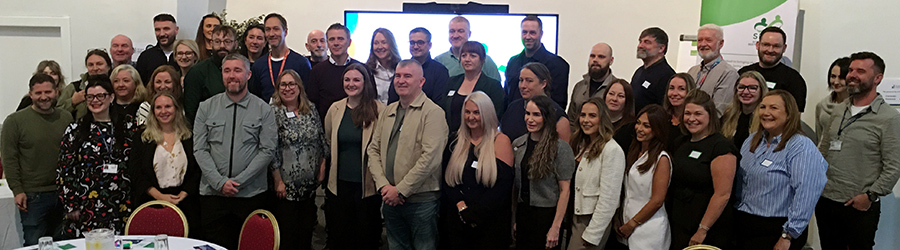
The 2025 SPRAG meeting was attended by Natalie Don-Innes, Minister for Children, Young People and The Promise.
In 2019, Dr Laura Steckley, Senior Lecturer in Social Work and Social Policy at the University of Strathclyde, led a plenary presentation session at the Scottish Institute of Residential Child Care Conference (SIRCC) aimed at exploring some of the complexities around the practice of physical restraint.
Watch the annual reporting videos
Following this, a group of people with care experience, practitioners, leaders, managers, policy leads and researchers came together and formed the Scottish Physical Restraint Action Group (SPRAG), hosted by CELCIS. Since then, the Group has been examining what is happening now, what else needs to be known, and what else needs to happen in children's houses, services, policies, and wider systems, to ensure the elimination of harm caused by physical restraint.
SPRAG is a member-led group and has grown to its current size with representation from over 70 organisations from a range of sectors and perspectives, individuals and organisations across Scotland.
SPRAG is hosted by CELCIS.
The Group has developed the following vision statement to guide its work and development. It reflects common ground and there are and will likely continue to be, differences in perspectives held by members of the group.
“We are committed to bringing about more effective, empathic, loving ways of holding children, young people and the adults who care for them in residential child care – in relationally rich environments, populated by adults who are properly equipped with requisite skills, knowledge and ways of being with children in the way that children need.
"We will work towards making coercive forms of holding less or even unnecessary and, when children are restrained, it is carried out relationally and with care.”
The Scottish Physical Restraint Action Group
The work of SPRAG has impact and influence on practice and policy in a number of ways, including:
- Collective voice: Scottish Government consultation responses submitted
- Collaboration with the Care Inspectorate on
- Defining restraint
- Annual data returns
- Restrictive practices self-evaluation tool
- Restrictive practices notification
- Incident reporting scenarios
- The ongoing development of a learning resource in relation to Serious Imminent Harm and Last Resort
- Physical Restraint Appreciative Inquiry
- Reflection and Action Learning Forum
‘Scotland must strive to become a nation that does not restrain its children’
As a group SPRAG was motivated and energised by the publication of The Promise – it consolidated and reaffirmed many of the conversations the group were having.
The Promise Scotland is represented on the group and Scottish Government has referenced SPRAG as close working partners in their Keeping the Promise implementation plan.
SPRAG has also been referenced in The Promise's Rights and Restraint route map.
How do I join?
The Scottish Physical Restraint Action Group meets online or in person 6-weekly with the option for members to become involved in additional sub-group activities as they arise.
If you are interested in finding out more about SPRAG and how you might become involved, please get in touch with a member of our team at celcis@strath.ac.uk putting 'Scottish Physical Restraint Action Group' in the subject line.
Resources
Holding Safely: This guide was written to help reduce those occasions when practitioners need to restrain a young person, to prepare them for the times when this is absolutely necessary and to more effectively meeting children and young people’s needs and upholding their rights in Scotland. This guidance was originally published in 2005. A further section entitled ‘Guidance on minimising the use of physical restraint in Scotland’s residential child care establishments’ was added in 2014.
Definitions: SPRAG members have worked together to collectively agree and recommend a set of definitions around physical restraint, that they feel accurately reflected experience and practice; and have supported efforts towards the development of a consistent understanding of these definitions. The Care Inspectorate has endorsed these recommended definitions and worked with the group to update and include these in the guidance document, ‘Records that all registered care services must keep and guidance on notification reporting’.
SPRAG Incident Reporting Scenarios: Incident reporting in settings where the residential school community and education provision share the same space. These scenarios, accompanied by the correct reporting procedures that follow, were jointly developed by members of SPRAG and the Care Inspectorate as a resource for the residential and education sector to aid decision making when reporting incidents.
Physical Restraint Appreciative Inquiry report: The University of Strathclyde has published ‘An Appreciative Inquiry into Holding in Residential Child Care: Pilot Report’ by Senior Lecturer Dr Laura Steckley and Lee Hollins from the University’s Department of Social Work and Social Policy, and CELCIS’s Improving Care Experiences Consultant Sarah Deeley and Education Consultant Michael Bettencourt.
The Reflection and Action Learning Forum (RALF) Report: The Reflective and Action Learning Forum (RALF) project is a Promise Partnership funded project aimed at developing reflective work cultures and individual workers’ reflective capacity within residential child care. This report highlights the process of rolling RALF out across Scotland and highlights the key learning and impacts of the project.
Response from CELCIS to the Scottish Parliament’s Call for Views on the Restraint and Seclusion in Schools (Scotland) Bill: The Restraint and Seclusion in Schools (Scotland) Bill was introduced on 17 March 2025 by Daniel Johnson MSP. It aims to minimise the use of restraint and seclusion of children and young people in schools.
Children (Care and Justice) (Scotland) Bill: The Scottish Physical Restraint Action Group (SPRAG) responded to the Scottish Government's consultation on the Bill in 2023.
Restraint and Seclusion (Prevention in Schools) (Scotland) Bill: The Scottish Physical Restraint Action Group (SPRAG) responded to consultation on the Bill in 2023.
Physical Intervention in Schools guidance: The Scottish Physical Restraint Action Group (SPRAG) responded to consultation on this guidance. March 2024.
Further Information
Reducing Restrictive Practice E-Learning Awareness Course
Restraint Reduction Scotland: RRS works collaboratively with families and professionals across health and social care, education and criminal justice services, for all adults and children who are at risk of restrictive practices.
Restraint Reduction Network: The Restraint Reduction Network is a network of organisations and individuals committed to eliminating the unnecessary use of restrictive practices. We want services to be safe, dignified and rights-respecting.