

The role of CELCIS in supporting positive transitions into adulthood for children and young people with experience of care in Scotland
CELCIS works alongside practitioners, policymakers and CELCIS’s Consultants with lived experience to make sure children and young people with experience of care can move into adulthood in a positive and supported way.
We work to support the implementation of legislation and policies designed to support children and young people’s transitions into adulthood. This work is grounded in research evidence and informed by extensive insight drawn from lived experience and professional practice.
Why transitions into adulthood work matters
Poorly planned or unsupported transitions into adulthood can create uncertainty and added pressure for young people living in foster care, kinship care or residential child care. Sudden changes, loss of trusted relationships, or a lack of practical and emotional support can make it harder to manage housing, money, education or work at a time when young people are still growing and learning.
When transitions are well planned and supported, young people are more likely to feel secure, build confidence and develop the skills they need for adulthood. Getting transitions right helps reduce disadvantage, supports wellbeing, and creates stronger foundations for young people to move forward positively into adult life.
The Transitions Wise Crowd: Supporting practitioners and policymakers to strengthen transitions into adulthood
As part of wider work to ensure that real-world experience informs policy to improve outcomes for care experienced children and young people, Kirsty Doull, Care and Transitions Lead at CELCIS and Mel Bridges, Improving Care Experience Consultant at CELCIS, facilitate the ‘Transitions Wise Crowd’.
What is the Transitions Wise Crowd (TWC)?
The TWC is a Scotland-wide network bringing together practitioners from all 32 local authorities and Scottish Government colleagues to improve policy and practice around transitions, Continuing Care, and Aftercare for children and young people with care experience.
The TWC provides a forum where Scottish Government colleagues can share emerging policy ideas with practitioners and draw on their insights and wisdom to inform the development of improved national policy that supports children and young people with experience of care as they move into adulthood.
“It is good to have direct feedback from practitioners across the country to understand how the policy is being implemented in different areas and to learn from some really creative initiatives that are being run across the country to support care leavers.”
- Scottish Government member of the TWC
Through facilitated discussions, the TWC provides a space to share positive practices, explore challenges, and discuss implementation considerations to help ensure that policy is shaped by those responsible for delivering it. The network also provides an opportunity to share learning from real practice, explore what supports positive transitions into adulthood, and better understand where barriers exist within the system.
Participation is rooted in curiosity, openness and a shared commitment to improving the experiences and outcomes of care experienced children and young people.
“It is always a really helpful space to learn from other practitioners and has also been helpful in making connections that have directly supported young people we are working with.”
- Practitioner member of the TWC
The Transitions Wise Crowd’s current areas of focus
The TWC network first met in November 2025 and has continued to meet regularly. The TWC is currently focused on supporting the Scottish Government in their writing of new guidance for Continuing Care and Aftercare.
The group formed four subgroups, each focusing on key areas of this guidance:
• Understanding and applying Continuing Care and Aftercare legislation: This group explored how practitioners interpret and apply legislation, where confusion arises, and what guidance and consistency is needed.
• Transitions, planning and multi-agency working: This group focussed on coordination, planning, and challenges experienced in the transition process.
• Supporting young people with complex or additional needs: This group looked at the additional systemic and practical challenges faced by practitioners when supporting young people with additional needs.
• Housing, health, stability, and continuing relationships: Housing and relational continuity are central to positive outcomes for children and young people leaving care. This group focused on practical and emotional stability for young people and carers.
The next steps for the TWC
The TWC now steps into its next phase as the Scottish Government and CELCIS consolidate what has been learned from the subgroups and further develops their thinking around the new guidance for Continuing Care and Aftercare, which will continue to be informed by the expertise and knowledge of the TWC network. The TWC will also consider any emerging issues and future changes which may impact the implementation and delivery of Continuing Care and Aftercare, with the aim of supporting the smooth and effective delivery of these services in local areas.
For more information about the Transitions Wise Crowd network and its work, email celcis@strath.ac.uk.
CELCIS research
Research plays a key role in informing evidence-based policy and practice that improves outcomes for care experienced children and young people. CELCIS undertakes and shares research relating to transitions, Continuing Care and Aftercare to strengthen the evidence base needed to support care experienced young people into adulthood.
In 2022, CELCIS published key findings from ‘Continuing Care: An Exploration of Implementation’, a research study examining how Continuing Care is implemented and interpreted across Scotland. The study highlighted both the enablers of effective implementation and the challenges that need to be addressed nationally and locally to improve support for care experienced children and young people as they enter adulthood. In 2026, Child & Family Social Work published an article by CELCIS based on this research.
Read the Continuing Care report
Consultation responses
CELCIS uses evidence from research, professional practice, and CELCIS’s Consultants with lived experience to respond to consultations that relate to transitions, Continuing Care and Aftercare.
In 2025, CELCIS responded to the Scottish Parliament’s Education, Children and Young People Committee's Call for Views on the Children (Care, Care Experience and Services Planning) (Scotland) Bill.
Read the response to the call for views
In 2024, CELCIS responded to the Scottish Government’s consultation on policy proposals for a Care Leaver Payment.
Read the Care leaver Payment consultation response
In 2024, CELCIS responded to the Scottish Government’s consultation on ‘Moving On’ from Care into Adulthood. The consultation sought examples of good practice and solutions to challenges faced by services and practitioners in Scotland in supporting care experienced children and young people as they leave care and move into adulthood.
Read the 'Moving on' consultation response
Participation in national networks
CELCIS participates in, and contributes to, many national networks in Scotland which support transitions into adulthood for children and young people with experience of care. These include Staf (Scottish Throughcare and Aftercare Forum) Forums; A Way Home Scotland, a coalition of individuals, organisations and authorities dedicated to ending youth homelessness in Scotland; Skills Development Scotland’s Care Experience Focal Point Group; and the Children and Young People’s Policy Network (CPON), which aims to collectively influence policy and legislation to improve the lives of all children and young people in Scotland.
Looking for more information or support?
If you would like to learn more about CELCIS’s work on transitions into adulthood or discuss how we can support your organisation or practice, please contact us at celcis@strath.ac.uk.
More information about transitions into adulthood on the CELCIS website
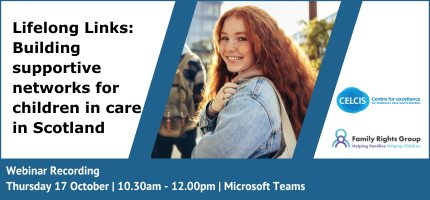
Evaluation of the Lifelong Links trial in Scotland
Lifelong Links supports children and young people who are in care by identifying and contacting relatives and other adults to keep them connected to each other and works to ensure that these relationships can continue to grow.
Watch our webinar which discussed the findings

Useful external links
Staf, the Scottish Throughcare and Aftercare Forum, is Scotland’s national membership organisation for all of those involved in the lives of young people leaving care.
Read about Staf and care leaver support
The HUB for SUCCESS works alongside people with care experience to get in, stay in and return to College and University. Their Transitions Toolkit resource is designed for care experienced learners at high school who are exploring their next step, as well as anyone who is a part of their support network.
Read about The HUB for SUCCESS
The Student Awards Agency Scotland (SAAS) provides financial supports for learners with experience of care.
Find out more on these pages