
Glossary
Some words or phrases have a specific meaning within the context of Active Implementation or refer to particular theories or practices. Definitions and explanations can be found on a specific glossary document when the word or phrase is {highlighted like this}.
Socially Significant Outcomes
The ANEW programme was originally established to reduce levels of child neglect and enhance the wellbeing of Dundee’s children. Through the development of a logic model, these ambitions remain but they are understood to be long-term outcomes that will take time to realise – particularly at the Dundee city level as this will require implementation of the ANEW programme across Dundee’s health visitors, nurseries and schools.
Using the logic model, the focus of the data work has been on the early indicators of change that signal that the ANEW programme is being implemented as intended and is having a positive impact on children, families and practitioners. Indicators of implementation and change have included:
- The number of health visiting teams, nurseries and schools (including the number of practitioners within these) implementing the ANEW programme, as these evidence the scale of implementation.
- The data from early concerns mapping exercises within the health visiting teams, nurseries and schools to understand whether the number and profile of children’s wellbeing concerns is changing and reducing over time, as well as understanding how practitioners are responding to and recording these concerns.
- The data from the observation tools and parental feedback questionnaires, as these evidence whether consistent, high-quality practice is being delivered.
- The outcomes of individual children supported through the ANEW programme to understand whether their needs are being met and reducing over time.
Outcomes of ANEW have included:
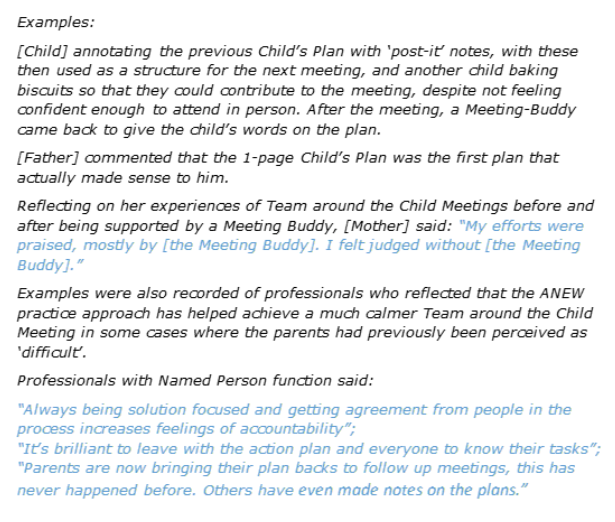
- Moving towards a shift in the balance of power within Team Around the Child meetings to ensure that children and families are at the centre of decision-making processes about their lives;
- Strengthened voice and participation of children and young people, by providing support before, during and after Team Around the Child meetings;
- Improved multi-agency working between Health Visiting and Early Years practitioners;
- Positive improvements in identifying early concerns suggested by the feedback from staff and parents.
Relevance of the ANEW learning
We strongly believe that the experience of and learning from the ANEW programme can be highly relevant in relation to:
- advancing the understanding of what it takes to support complex transformational change in Scotland;
- strengthening early intervention and prevention approaches;
- defining practices and processes underpinning collaborative, multi-agency working;
- implementing high-quality strengths-based practice that listens to and puts children, young people and their families at the centre;
Key policies and national strategic programmes for which the ANEW journey might offer important learning include:
- Getting it Right for Every Child (GIRFEC), including the refreshed Policy Statement;
- You can read the GIRFEC refresh practice exemplar published by Scottish Government of Camperdown Meeting Buddy practice here.
- Keeping The Promise;
- The incorporation of the United Nations Convention on the Rights of the Child (UNCRC) into the Scots Law;
- Whole Family Wellbeing Funding Programme; and, overall, the potential to advance the alignment across the policy landscape.