


Glossary
Some words or phrases have a specific meaning within the context of Active Implementation or refer to particular theories or practices. Definitions and explanations can be found on a specific glossary document when the word or phrase is {highlighted like this}.
Child neglect is a multi-faceted problem that exists within a complex children's services system, and there is no ready-made response. It was therefore essential to put in place the skillset required from CELCIS to ensure that our team was well-equipped to work alongside and support the people and agencies working to address the issue of neglect. The main role of CELCIS team was to support the people and teams involved around the envisaged change.
Read about the CELCIS team in the section on ‘Enabling Context'
Once the CELCIS team was in place, it was important to start building the groundwork. We needed to be informed by evidence and guided by existing research and theory on childhood development and complex systems.
Firstly, it was important to better understand the complexity of the current challenges, rather than just focus on treating the symptoms. To do this, we were informed by what is known as ‘Complexity Theory’. Complexity Theory helps us focus on identifying and addressing the root cause of complex problems, such as the challenges in relation to effective early intervention to support children and their families described in the Introduction. It draws attention to the diversity of and the interconnection between the stakeholders that form the communities (or the social networks) of interest. Complexity theory pushes us to map and engage all stakeholders in the design, implementation, and evaluation of programmes or interventions, ensuring that solutions are inclusive and responsive to the local community. This helped to inform our approach, as did the work of the other research and evidence. These included:
- Urie Bronfenbrenner’s Ecological Systems theory, which states that a child’s development is influenced by different layers of the environment around them. This guided our team to hone in on a child’s immediate environment, including their family, school and neighbourhood – known as a child’s microsystem – as well as their relationship with family, friends, universal services and communities. We paid attention to the interactions between these different parts of a child’s life, and the influence of wider systems that may impact a child’s development, such as societal and cultural factors, geographic location, the local economy and government policies, and considered the impact of changes in circumstances over time.
- James Heckman’s curve, which illustrates how investing in early childhood development, through, for example, high-quality early childhood programmes like preschool education and parenting programmes, can have a lasting impact on a child's cognitive and social-emotional development. This can mean significant long-term benefits for individuals, and society as a whole.
- Donella Meadows’ work, particularly that on identifying highly effective ‘leverage points', which are the places in a system where a small change can produce a big impact, such as changing people’s mindsets or shifting the overall goals of a system. By identifying such leverage points, we can understand where to focus our efforts so that we can intervene more strategically in a system.
The evidence that we reviewed showed us that a child's wellbeing is influenced by many interconnected factors, meaning that neglect cannot be addressed by isolated actions or single agencies. Rather, it requires a holistic and multidisciplinary approach based on collaboration and coordination between different sectors and stakeholders across a whole ‘system’. The involvement of all the different parts of the ‘system’ in identifying the key leverage points (where to channel resources to ensure the biggest impact for children and families) can lead to more effective and long-lasting solutions, better use of resources, and improved outcomes.
Selecting a framework for innovation – Why Active Implementation?
Informed by evidence, we then set out the steps needed to support whole systems change as part of the ANEW programme. First, we needed to identify the approaches that would enable such complex change.
Grappling with the widely experienced disconnect between policy design and implementation, it was important to better understand how to translate policy into changes on the ground. To do this, we delved more deeply into implementation science and started to build our expertise in using Active Implementation.
Active Implementation is an integrated, data-driven, problem-solving approach. It helps organisations to effectively implement new practices to scale and sustain complex interventions, as well as identify and address the barriers to effective implementation.
Although Active Implementation hadn’t been widely used in Scotland at the time the ANEW programme started, the approach was built on decades of implementation science research and practitioner-scientist activities focused on bridging the gap between research and practice, and improving human service systems, organisations and outcomes.
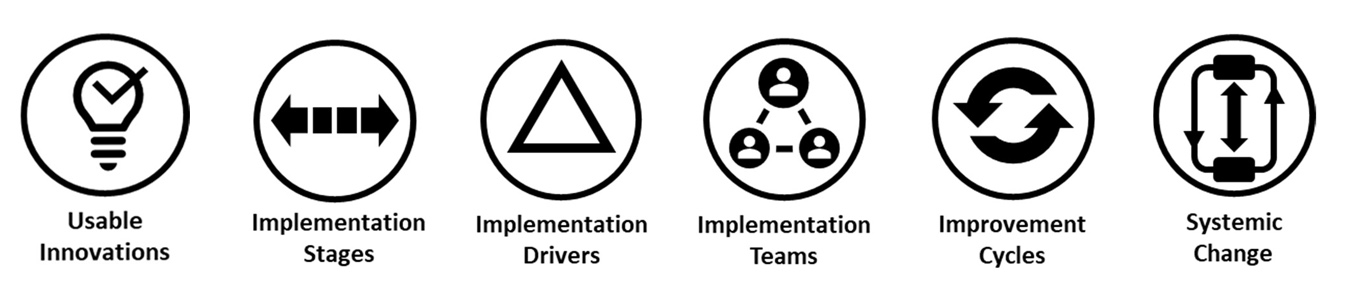
Through a set of six frameworks (shown below), Active Implementation attends to the human element involved in the change process, for example, it helps us think about who needs to be doing what differently to improve outcomes for children and families. This shifts the focus towards providing the guidance, support and resources required when people embark on doing something new or different. The approach helps us pay attention to the infrastructure needed to ensure that improvements are both scalable and sustainable.
Learn more about the Active Implementation Frameworks
The Formula for Success
With Active Implementation identified as our chosen approach, we turned to its overarching ‘Formula for Success’ to guide our thinking and ways of working. The Formula for Success draws attention to the scale of the envisaged change, moving beyond isolated results based on small pockets of good practice, to supporting outcomes that are socially significant, i.e. the overall goal that is experienced by everyone who stands to impact from the change. In the case of the ANEW programme, this was to support three local authorities in Scotland to strengthen prevention and early intervention for children and young people experiencing neglect, their families and carers.
With our goal set, we then needed to use the formula to help achieve our goal. To do this, attention should be paid to three key factors:
- Effective Practices (The WHAT) – The effective practice is a programme or a practice that varies from the standard or is new. To do this, consensus must be reached across the ‘system’ and a well-conceived view developed about what exactly is to be implemented, ensuring that this change is described in a clear and usable manner. Effective practices should be teachable, learnable, doable and assessable.
- Effective Implementation (The HOW) – this refers to how effective the implementation is, seeing implementation not as a single event, but as a process that has a number of interconnected stages. This is also about creating and maintaining the supporting infrastructure needed to ensure that the change is in place, is used as intended and leads to the intended outcomes.
- The supportive policy and organisational context (The ENABLING CONTEXT)- this is about considering where the change is taking place and ensuring that the environment/context enables it to be sustainable in the long term. It involves creating readiness and alignment across the system, whilst also building local implementation teams and feedback loops that contribute to systemic change.
All three factors are critical elements in the Formula for Success, as illustrated by the use of multiplication signs in the formula – the absence of any of the factors will not lead to socially significant outcomes, and a weak factor will decrease the impact of the other ones.

In this video Emma Hanley, Children's Services Implementation Lead at CELCIS, discusses the rationales, the evidence and the approaches underpinning the work.